Inspector Javert
Les MisérablesInspector Javert is a police inspector defined in these scenes by vigilance, suspicion, and an insistence on immediate authority. His attention fixes on Madeleine before he openly confronts Jean Valjean: first he singles Madeleine out as a man capable of an extraordinary feat, then he arrests him at Cosette’s mother’s bedside. The juxtaposition makes Javert’s watchfulness consequential. He does not merely observe the story’s changes in social standing; he is positioned to challenge the identity on which Madeleine’s authority depends.
Identity and Bearing
Javert serves as an inspector in the town where Madeleine has become a prominent manufacturer and public figure. He arrives only after Madeleine’s fortune is established and he is already known as Monsieur Madeleine, so Javert has not witnessed the beginnings of his rise. Javert owes his post to the protection of M. Chabouillet, secretary to the Minister of State, Count Anglès, who was then prefect of police in Paris. This account gives his office a specific institutional route into local life: he is a police official appointed through a connection to the capital, arriving after the reputation he will scrutinize has already taken shape.
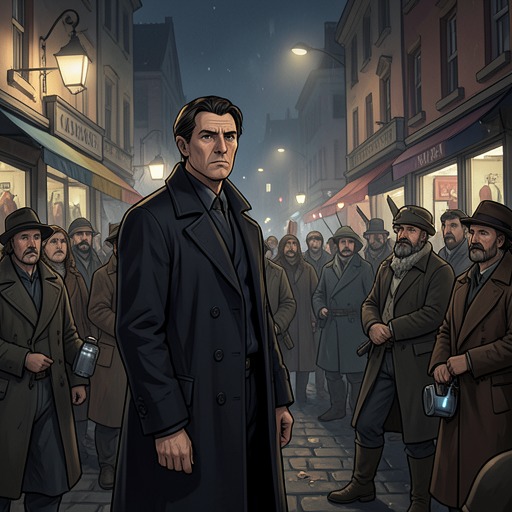
His appearance is rendered as an extension of the unease he produces. A flattened nose, deep nostrils, and enormous side-whiskers frame a face that seems at once severe and animal. His sparse forehead is hidden by hair falling over his brows; between his eyes sits a permanent furrow like a star of anger. The description emphasizes his jaw, obscure gaze, pinched mouth, and commanding air. At rest he resembles a watchdog; when he laughs, the comparison turns to a tiger. The rare laugh is not a softening of his severity: it exposes his teeth and gums and makes his face more fearsome. Javert’s physical portrait thus prepares the reader for a figure whose attention feels like surveillance and whose authority carries a threat even before he acts.
Suspicion of Madeleine
The narration singles Javert out as the one man in the town and district who resists a contagion associated with Madeleine. Whatever Madeleine does, Javert remains rebellious against it, as though an incorruptible, unquiet instinct keeps him awake and uneasy. The passage does not make that instinct a proven discovery; it establishes instead a durable resistance to the admiration surrounding Madeleine. Javert’s defining difference is that he cannot be drawn into the prevailing response.
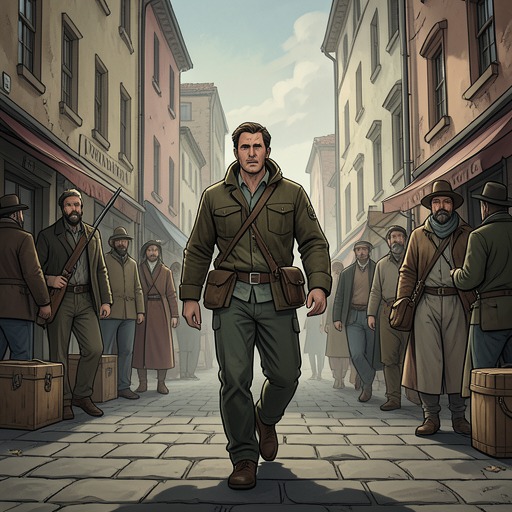
That resistance becomes legible during the attempt to lift a cart. Javert speaks from behind Madeleine, whom he has not noticed arriving, and says that the trapped men lack not goodwill but strength: lifting the vehicle on one’s back would require an extraordinary man. He then looks fixedly at Madeleine and stresses that he has known only one man capable of doing what is being asked. Madeleine startles. Javert does not openly identify him as Jean Valjean in this exchange, but the pointed reference makes the remark more than a general observation about strength. His direct gaze, deliberate emphasis, and choice to address Madeleine turn an apparently practical discussion into a test of recognition. The scene shows suspicion working through insinuation before it becomes arrest.
Arrest at Cosette’s Mother’s Bedside
Javert’s watchfulness becomes physical when he appears at the bedside of Cosette’s mother. She sees him behind Jean Valjean and signals for him to look back. Javert takes Jean Valjean by the collar; Cosette’s mother sees the mayor bow his head, and the sight makes her feel that the world is vanishing. Javert then laughs in a way the narration presents as appalling. For her, the arrest overturns what she thought she understood about the mayor and her immediate hopes. For Javert, it is the moment when suspicion becomes an exercise of police power.
The arrest continues even after Cosette’s mother dies. Jean Valjean places his hand over the hand Javert has on him and opens it as easily as a child’s hand. He tells Javert that he has killed her. Javert, furious, refuses to hear reasons and presses for immediate departure: the guard is downstairs, and they must go at once or he will use the handcuffs. The sequence sets two responses to the death against one another. Jean Valjean makes the woman’s death the central fact and addresses Javert’s responsibility; Javert treats further discussion as an obstacle to carrying out the arrest. His words and conduct establish his priority in the scene without settling, by themselves, the full moral or legal account of what has happened.
Narrative Role
Across these episodes, Javert’s role is to turn concealed identity into public danger. At the cart, he watches Madeleine closely and hints that he recognizes a capacity associated with another man. At the bedside, he seizes Jean Valjean openly and insists that procedure continue despite the death before him. The movement from fixed gaze to hand on the collar gives his suspicion a clear dramatic progression: first an unsettling indication, then an arrest.
The contrast between Javert’s unyielding command and Jean Valjean’s response is especially sharp at the bedside. Jean Valjean opens Javert’s grip without forceful struggle, then speaks of the dead woman; Javert answers by rejecting reasons and invoking the waiting guard and handcuffs. The scenes therefore characterize Javert not only through his authority but through what he will not pause to hear. His vigilance is effective in exposing danger to Madeleine’s assumed identity, yet its uncompromising expression makes the arrest an immediate human crisis rather than a neutral administrative act.